
PROJECT / 04
Galdieria Microalgae Wastewater Resource Recovery Project
Wastewater Treatment × Resource Recovery
Turning wastewater into a cycle that creates resources.
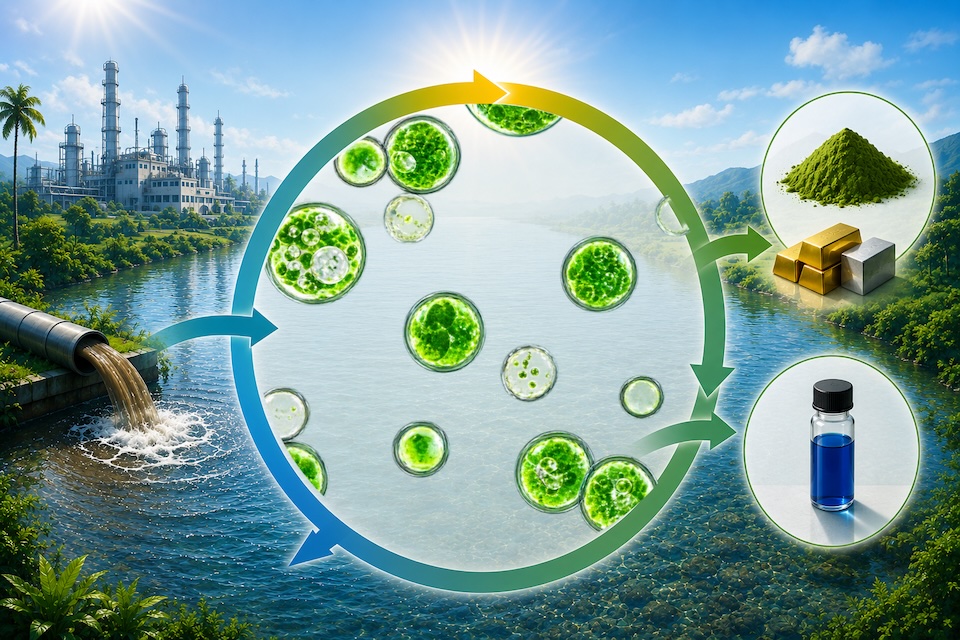
This project connects organic matter in industrial wastewater with Galdieria microalgae cultivation to improve water environments and recover valuable resources at the same time.
CONTEXT
From treatment target to resource
Wastewater from food, sugar, distillery, and textile factories contains sugars, starches, fats, and proteins—the carbon and nutrients that can support biological production. By redirecting these substances into algae cultivation instead of simply purifying and discarding them, wastewater treatment can become the starting point for a new resource cycle.
WHAT WE DO
Implementation
Find partners with industrial wastewater
Identify fields where wastewater can support cultivation.
We will explore companies with wastewater suitable for Galdieria cultivation, focusing on Southeast Asia and southern India.
- Distilleries, sugar, food, and textile industries
- Wastewater characteristics and volumes
- Selection of suitable demonstration fields
Cultivate Galdieria using wastewater
Make water-quality improvement and biomass production work together.
We will use Galdieria’s ability to grow in strongly acidic and high-temperature environments to assess cultivation conditions using organic matter in wastewater.
- Autotrophic and heterotrophic growth
- Water-quality improvement and biomass production
- Assessment of cultivation and operating conditions
Build a cultivation and demonstration framework in Asia
Connect India, Malaysia, and the Philippines through durable field systems.
We will work with universities, research institutions, and local partners to design demonstration sites that account for national regulations and logistics.
- Collaboration with universities and research institutions
- Facilities, logistics, and regulatory design
- A framework for continuous field validation
Use cultivated Galdieria for resource recovery
Connect the biomass we produce to downstream industries.
We will use the precious-metal adsorption properties of Galdieria cell surfaces to apply post-treatment biomass to resource recovery and other valuable uses.
- Recovery of gold, palladium, and other metals
- Potential food, materials, and research applications
- Turning wastewater treatment into value creation
FIELD & PARTNERS
From Asia to water environments around the world
We will build demonstration models in regions with different wastewater and business conditions, then scale a locally rooted circular model.
- Philippines | Gold-recovery demonstration at a natural mine
- India | Exploration of cultivation models using industrial wastewater
- Malaysia and the Philippines | Demonstration sites with universities and research institutions
PROJECT TEAM
Build the full process with partners who bring different strengths
TECHNOLOGY
Galdieria Inc.
Provides Galdieria cultivation and precious-metal adsorption technology.PROJECT ORGANIZER
Leave a Nest Co., Ltd.
Coordinates challenge definition, partner discovery, validation, and commercialization.FIELD PARTNER